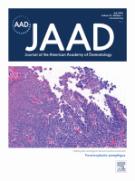

Morphological and immunohistochemical clues for the diagnosis of cutaneous leishmaniasis and the interpretation of CD1a status - 16/02/16
 , José Luis Rodriguez-Peralto, MD, PhD b
Abstract |
Background |
CD1a immunoexpression by amastigotes of Leishmania major and L tropica has been demonstrated.
Objective |
We studied the CD1a and the langerin status of amastigotes in cases of L infantum.
Methods |
We investigated 19 cases of cutaneous leishmaniasis. All cases were immunostained with CD1a, langerin, and CD68. We also studied 4 cases of visceral leishmaniasis.
Results |
We found expression of CD1a by amastigotes in all of these 19 cases. CD1a− amastigotes are found in reticular areas of the dermis. The pattern of CD1a immunostaining of amastigotes is characteristic, with peripheral positivity, a negative nucleus in the center, and reinforcement of the kinetoplast in 1 pole. Leishmania amastigotes were langerin-negative. Visceral Leishmania amastigotes also express CD1a.
Limitations |
Our study was limited because it only included cases of infection by L infantum.
Conclusions |
(1) L infantum is CD1a+, (2) the pattern of CD1a immunostaining of amastigotes is peculiar, (3) CD1a− amastigotes are found in reticular areas of the dermis, and (4) visceral Leishmania amastigotes also express CD1a.
Il testo completo di questo articolo è disponibile in PDF.Key words : amastigotes, antigen transfer, CD1a, granuloma, granulomatous inflammation, Langerhans cell, langerin, Leishmania, Leishmania infantum, Leishmania major, Leishmania tropica, leishmaniasis, MTB1, transepidermal elimination
Mappa
| Funding sources: None. |
|
| Conflicts of interest: None declared. |


Vol 74 - N° 3
P. 536-543 - marzo 2016 Ritorno al numero Articolo precedente
- Why do port-wine stains (PWS) on the lateral face respond better to pulsed dye laser (PDL) than those located on the central face?
- Wenxin Yu, Gang Ma, Yajing Qiu, Hui Chen, Yunbo Jin, Xi Yang, Xiaojie Hu, Tianyou Wang, Lei Chang, Henghua Zhou, Wei Li, Xiaoxi Lin

- Translating psoriasis guidelines into practice: Important gaps revealed
- Reva Bhushan, Mark G. Lebwohl, Alice B. Gottlieb, Kevin Boyer, Elaine Hamarstrom, Neil J. Korman, Robert S. Kirsner, Arthur J. Sober, Alan Menter
Benvenuto su EM|consulte, il riferimento dei professionisti della salute.
L'accesso al testo integrale di questo articolo richiede un abbonamento.
Già abbonato a @@106933@@ rivista ?